
For global buyers, choosing Kids Puzzle Toys requires more than colorful packaging and attractive wholesale prices. Product fit, safety, durability, and learning value must work together. In real sourcing projects, buyers often compare wooden jigsaws, toddler peg boards, 3D construction sets, logic games, and travel puzzles. Each format serves a different age group, skill level, retail channel, and shipping condition. A puzzle popular in one region may seem too difficult, fragile, or culturally unfamiliar elsewhere. That difference matters.
This introduction opens our guide to the Top 10 Types of Kids Puzzle Toys for Global Buyers. It focuses on practical choices that can survive careful product evaluation. We examine age grading, piece size, material quality, surface finish, packaging, and instructions. These details affect safety, customer trust, returns, and repeat orders. Wooden pieces should feel smooth, not merely look natural. Cardboard should resist bending during ordinary handling. Small parts require clear age guidance and responsible retail communication. Buyers should also request credible test reports and verify claims with suppliers. Standards and documentation vary by destination. Do not treat one certificate as universal proof. The guide also considers inclusive play, screen-free learning, storage, and transport efficiency. Some recommendations may need adjustment. Children differ, and market data is never perfect. Still, these ten categories provide a clear starting point for informed purchasing and safer, more useful assortments.
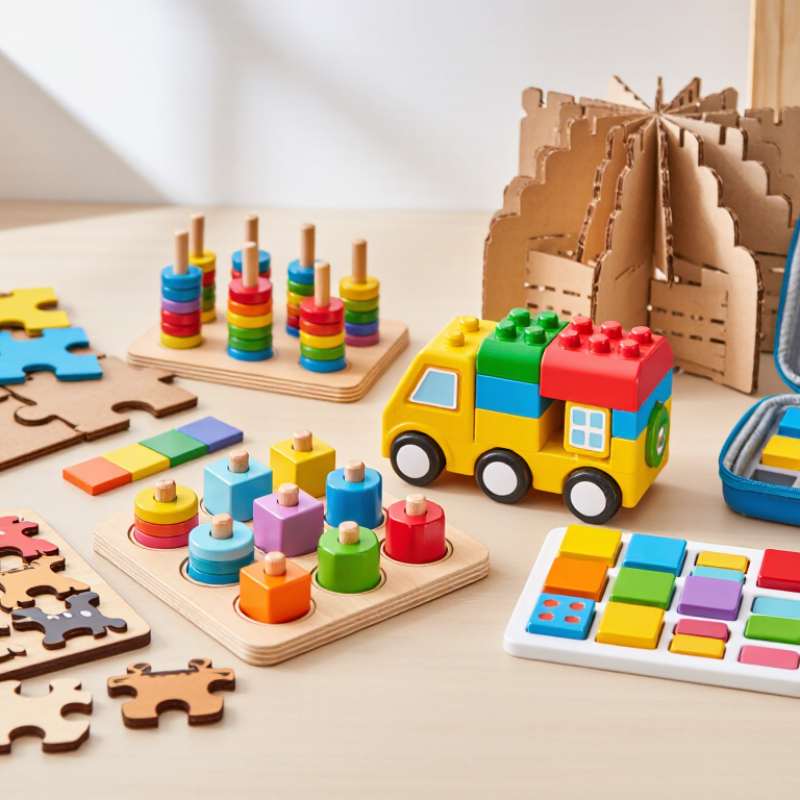
A suitable children’s puzzle toy must be safe, clear, and adaptable across markets. The European Commission’s 2023 Safety Gate report listed toys among the most frequently notified product groups. This shows why buyers should request documented testing, not attractive packaging alone. Check for age grading, small-part warnings, material safety, and secure piece connections. A puzzle should survive repeated handling, drops, and occasional chewing.
Learning value matters, but it needs evidence. UNICEF and the LEGO Foundation’s Learning through Play research links play with cognitive, physical, social, and emotional development. Buyers can look for puzzles that build matching, sequencing, spatial reasoning, or fine-motor control. A child placing a thick wooden piece into a board is easier to understand than a vague “educational” claim. Still, difficulty must match the child’s development. Some puzzles are too hard. Frustration is not always learning.
Global suitability also depends on language, culture, and logistics. Use simple visual instructions, limited text, and symbols that remain understandable after translation. Offer inclusive images and avoid assumptions about family life or daily routines. Packaging should resist humidity, compression, and long-distance transport. According to the World Bank’s Logistics Performance Index 2023, customs efficiency and shipment reliability vary widely between countries, so compact packaging can reduce handling risks. Buyers should also review regional standards, labeling rules, and recycling requirements before ordering. “One design fits all” sounds efficient, but it rarely survives real markets.

Good puzzle selection starts with design, age fit, and learning purpose. The ten useful categories are peg puzzles, inset puzzles, jigsaw puzzles, matching puzzles, sequencing puzzles, maze puzzles, tangram puzzles, 3D construction puzzles, logic puzzles, and sensory puzzles. Each category supports different skills, from hand control to spatial reasoning.
Peg puzzles use large pieces and strengthen grasping skills.
Inset puzzles teach shape recognition through clear outlines.
Jigsaw puzzles develop patience, visual scanning, and part-to-whole thinking.
Matching puzzles connect pictures, colors, or objects.
Sequencing puzzles help children understand order, routines, and simple cause-and-effect.
Maze puzzles encourage planning, while tangrams introduce geometry through movable shapes.
Three-dimensional construction puzzles build balance and spatial awareness.
Logic puzzles offer early problem-solving challenges.
Sensory puzzles add textures, sounds, or moving elements for children who learn through touch.
In practical sourcing, buyers should check piece size, surface finish, edge smoothness, and cleaning needs. Wood, coated paperboard, and food-contact-safe silicone may suit different product designs, but material claims need reliable documentation. Clear age guidance matters. A difficult puzzle can frustrate a young child, even when its artwork looks attractive. I have seen attractive sets with weak fit between pieces, which reduced play value. Some categories also overlap. A textured maze may support both sensory exploration and planning. That overlap is useful, but it can make product positioning less precise. Regional language, cultural images, and packaging instructions also deserve careful review before distribution.
Puzzle categories include jigsaw, stacking, sorting, shape-fitting, peg, gear, maze, tangram, sliding, and magnetic designs. In practical sourcing reviews, buyers should inspect function before appearance. Pieces need smooth edges, stable connections, and sizes that resist swallowing. A beautiful puzzle can still fail basic safety checks.
Material selection matters. Solid wood should have sealed surfaces and low splinter risk. ABS and polypropylene need verified composition and reliable impact resistance. Silicone parts should remain odor-free and flexible after repeated use. Avoid loose coatings, brittle plastic, and exposed magnets. Small parts require special attention.
CPSC’s Toy-Related Deaths and Injuries report recorded an estimated 231,020 toy-related injuries treated in U.S. emergency departments in 2023. The report also noted 10 toy-related deaths. These figures make testing more than paperwork.
Ask suppliers for test reports covering heavy metals, phthalates, flammability, sharp points, choking hazards, and magnetic components. For U.S. shipments, review ASTM F963-23 and applicable CPSC requirements. For European markets, check EN 71, while ISO 8124 may support broader international evaluation. Standards differ by age label and destination. Do not trust one certificate blindly. A report may cover only one material or production batch. Independent laboratory verification is safer, although it adds time and cost. Buyers should also request traceable batch records, packaging warnings, and samples from mass production. I still see one weakness: visual inspection alone cannot prove chemical safety.
Choosing puzzle toys requires more than checking a colorful package. Age recommendations should match attention span, hand control, and frustration tolerance. For toddlers, knob puzzles, peg puzzles, and shape sorters support recognition and coordination. Large pieces are easier to grasp and harder to misplace.
For preschoolers, stacking puzzles, simple jigsaws, and floor puzzles encourage sequencing and visual memory. A four-year-old may enjoy completing a 24-piece scene, then proudly explaining every detail.
Older children can explore tangrams, maze puzzles, logic puzzles, magnetic puzzles, and 3D construction puzzles. These formats develop spatial reasoning, planning, patience, and flexible thinking. A maze with several routes can turn a quiet afternoon into a problem-solving challenge.
Tangram pieces also invite more than one answer. That matters.
Play value depends on repeat use, not only first-day excitement. Look for sturdy materials, clear illustrations, smooth edges, and pieces that fit without excessive force. A puzzle should offer manageable difficulty, with enough challenge to encourage effort. Too easy becomes boring. Too hard becomes discouraging.
Buyers should also consider language-free designs for international markets, especially when children may not read the instructions.
Age labels help, but they are not perfect. A confident five-year-old may solve an older child’s puzzle, while another child may need more time. This is where careful observation matters.
The best choice leaves room for success, mistakes, and another attempt.
Global buyers usually compare ten puzzle categories: wooden boards, jigsaw sets, peg puzzles, stacking puzzles, magnetic puzzles, 3D models, floor puzzles, logic games, matching cards, and sensory puzzles. Each type serves a different age group and learning purpose. A two-year-old may need large, smooth pieces, while older children can manage smaller interlocking parts. Product quality begins with safe materials, accurate cutting, durable printing, and secure packaging. Every piece should fit without force. No sharp edges.
Customization can improve market relevance. Buyers may request local languages, cultural illustrations, age labels, package sizes, or educational themes. However, customization should not weaken safety checks. Artwork needs clear contrast, and small components require careful age classification. Reliable suppliers should provide material records, inspection reports, and test results for the destination market. Requirements differ across regions, so generic certificates may not be enough.
Market demand changes quickly. Parents increasingly seek screen-free toys that build coordination, memory, and problem-solving skills. Retailers also prefer compact packaging and flexible order quantities. A practical sourcing review should test samples before discussing large production. Check the box corners, examine the print, and repeat assembly several times. Small flaws matter. A low unit price can hide high return costs, weak instructions, or damaged packaging. One common mistake is trusting photographs too much. Physical samples reveal what online catalogs cannot. Suppliers may also need better feedback than buyers usually provide.