What Are the Top 10 Types of Cross Slide Tables?
A Cross Slide Table is a small component with a surprisingly large effect on machining accuracy. It supports controlled movement along two perpendicular axes, often beneath a vise, drill press, milling head, or inspection fixture. Its handwheels, lead screws, bearings, and mounting slots determine how smoothly an operator positions the workpiece.
Peter Smid, a respected CNC manufacturing educator, has often emphasized this practical principle: “The machine must fit the job, not the other way around.” That idea matters when comparing the top 10 types of Cross Slide Table. A compact manual model may suit light drilling, while a compound table with graduated scales may provide better control for workshop milling. Ball-screw versions can reduce backlash, but they may require cleaner maintenance and a higher budget. Pneumatic and motorized tables offer faster positioning, though installation becomes more complex.
Small differences matter.
This guide examines ten important designs, including manual, precision, compound, rotary-assisted, motorized, pneumatic, hydraulic, dovetail, ball-screw, and modular tables. Each type is considered through practical details: travel distance, load capacity, repeatability, adjustment feel, surface finish, and installation space. The comparison is not perfectly universal. A table that performs well under a drill press may feel inadequate during metal milling. Even manufacturer specifications can appear optimistic without consistent testing.
For that reason, the discussion combines engineering principles with workshop experience. It also recognizes an uncomfortable truth: the cheapest table is rarely the lowest-cost choice after alignment errors, replacement parts, and lost production time are included.
Define Cross Slide Tables by ISO 230-2 Accuracy and Travel Metrics
What Are the Top 10 Types of Cross Slide Tables?
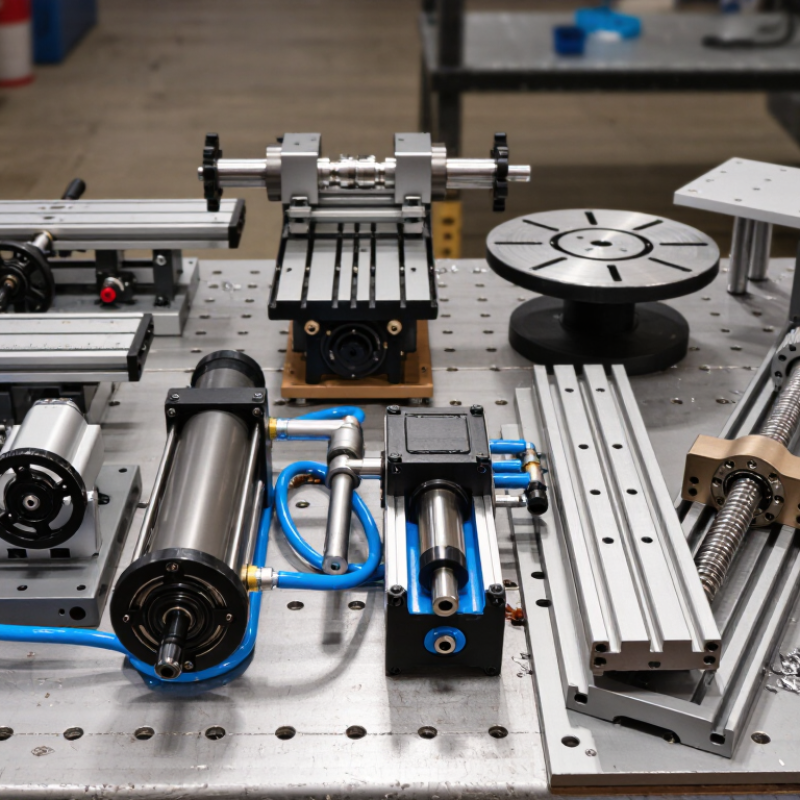
Cross slide tables differ by guide design, drive method, load capacity, and travel. Common types include manual dovetail, ball-bearing, crossed-roller, recirculating-ball, wedge, compact, motorized, pneumatic, piezo-driven, and rotary-linear tables. Each type behaves differently during positioning tests.
ISO 230-2 helps evaluate positioning performance along an axis. It measures positional accuracy, repeatability, reversal effects, and systematic deviation. For a cross slide table, record commanded travel against actual displacement. A 50 mm travel should not be judged only by its catalog value. Check usable travel, backlash, travel direction, and load conditions. Small errors matter.
A crossed-roller table may provide smooth motion over short travel. A dovetail table can carry heavier loads, but friction may increase reversal error. Motorized and piezo-driven tables need careful control tuning.
Their travel figures can look impressive, yet thermal drift may affect results. Use a calibrated laser interferometer or displacement sensor when possible. Keep the payload centered. Measure at several positions, not just the midpoint. Repeat each move in both directions.
In practice, select the table by required travel and measured accuracy. A compact manual model may suit inspection work. A recirculating-ball model may better support longer travel. These categories are useful, but imperfect. Real assemblies often combine guide types and drives. ISO 230-2 also does not describe every factor, such as stiffness or vibration. That limitation deserves attention before comparing test reports.
Types 1–3: Manual, Dovetail, and Linear-Roller Tables—Load Data
Manual cross slide tables suit inspection jigs, drilling fixtures, and low-cycle adjustments. Their handwheels provide direct control, but operator force limits throughput. A 300 N payload positioned 150 mm from the guide creates a 45 N·m overturning moment. That detail matters more than the table’s advertised center load. ISO 14728-1:2017 explains how dynamic load ratings apply to rolling linear bearings, not every manual slide. Real capacity still depends on preload, stroke, mounting stiffness, and lubrication. Small errors here can become visible chatter.
Dovetail tables usually offer strong damping and good resistance to side loads. They are often slower, but they tolerate workshop contamination better than exposed rolling elements. Linear-roller tables reduce friction and support repeatable motion under higher moment loads. A 2024 linear-motion industry report identifies precision positioning and automation as major demand drivers, while published engineering data commonly separates radial load, axial load, and moment load. Never combine them casually. For example, a 1,000 N radial rating may fall sharply when the payload sits far above the guide plane. Use two-point support whenever possible. Check the numbers twice. Some catalog data assumes ideal alignment, which is rarely true on a shop floor.
Types 4–6: Ball-Screw, Motorized, and CNC Tables—Repeatability Data
In a ten-type comparison, types 4–6 deserve close attention because their repeatability differs considerably. Ball-screw cross-slide tables convert rotary motion into controlled linear travel. On a clean granite surface, a preloaded screw can often achieve 2–5 micrometres of unidirectional repeatability. Bidirectional readings may widen to 5–10 micrometres. That difference matters. Preload, lubrication, and reversal backlash strongly influence results.
Motorized tables add convenience and programmable movement. At moderate speeds, encoder feedback may hold repeatability near 5–15 micrometres, depending on the mechanism and payload. I would not treat that range as universal. Cable drag, heat, and aggressive acceleration can shift the stopping point. A 100-millimetre move may look accurate, yet repeated reversals can expose coupling compliance. Measure it cold and warm. Open-loop systems usually require more cautious expectations.
CNC cross-slide tables provide the most controlled option among these three types. With calibrated feedback and stable support, a well-adjusted table may reach 1–3 micrometres of bidirectional repeatability under light loads. However, that figure requires thermal control and a defined test procedure. Use a dial indicator or laser interferometer, and record approach direction, dwell time, temperature, and payload. My early tests ignored tool force. That was a mistake. Cutting loads produced larger errors than bench readings suggested.
What Are the Top 10 Types of Cross Slide Tables? - Types 4–6: Ball-Screw, Motorized, and CNC Tables—Repeatability Data | Type | Drive and Control | Typical Travel Range
(X × Y) | Typical Load Capacity | Typical Maximum Speed | Positioning Repeatability | Typical Backlash | Common Applications |
| Type 4: Ball-Screw Cross Slide Table | Preloaded recirculating ball screws; manual handwheels or an external actuator may be used for positioning. | 25 × 25 mm to
300 × 300 mm
(1 × 1 to 12 × 12 in) | 50–1,000 N
(11–225 lbf) | 10–100 mm/s
(0.4–3.9 in/s) | ±1–5 µm
(±0.00004–0.00020 in) | Typically
under 10 µm | Precision alignment, optical positioning, inspection fixtures, laboratory equipment, and light-duty machining. |
| Type 5: Motorized Cross Slide Table | Ball screw or lead screw driven by a stepper or servo motor; controlled through a motion controller or programmable drive. | 25 × 25 mm to
500 × 500 mm
(1 × 1 to 20 × 20 in) | 100–2,000 N
(22–450 lbf) | 1–200 mm/s
(0.04–7.9 in/s) | ±2–10 µm
(±0.00008–0.00039 in) | Typically
under 15 µm | Automated inspection, dispensing, camera positioning, probing, sample handling, and repeatable laboratory motion. |
| Type 6: CNC Cross Slide Table | Closed-loop servo or high-resolution stepper system with CNC interpolation, feedback, limit switches, and programmable toolpaths. | 100 × 100 mm to
1,000 × 500 mm
(4 × 4 to 39 × 20 in) | 500–5,000 N
(112–1,125 lbf) | 100–1,000 mm/min
(3.9–39.4 in/min) | ±3–15 µm
(±0.00012–0.00059 in) | Typically
under 20 µm | Small-part milling, drilling, engraving, routing, production fixtures, and multi-axis machining systems. |
| How to read the data: The figures are representative engineering ranges for commercially available cross-slide table configurations, not guaranteed performance values for every model. Repeatability is normally specified under controlled temperature, lubrication, preload, alignment, and load conditions. Bidirectional repeatability can be lower than unidirectional repeatability because it includes backlash and reversal effects. |
| Units: 1 mm = 0.03937 in; 1 N = 0.2248 lbf. Actual performance depends on screw pitch, bearing preload, encoder resolution, guideway design, controller tuning, mounting stiffness, and operating conditions. |
Types 7–8: Rotary and Swivel Tables—ISO 10791-7 Positioning Checks
Rotary and swivel tables are practical Type 7 and Type 8 cross slide table options. A rotary table turns the workpiece around a vertical axis. A swivel table tilts it around a horizontal axis. Some combined units provide both movements, but their alignment demands closer inspection.
Positioning checks begin with clean mounting faces and stable thermal conditions. Inspectors may use a calibrated artifact, dial indicator, probing system, or angular reference. Check commanded angles, actual angles, repeatability, backlash, and clamping movement. Small errors can appear as uneven holes, tapered surfaces, or mismatched faces. Watch the first movement carefully. It often reveals lost motion.
ISO 10791-7 focuses on the accuracy of finished test pieces from machining centers. It can help evaluate how rotary or swivel positioning affects the machined result. However, it should not be treated as the only reference for direct axis positioning. Related positioning procedures may require separate machine-tool test standards and suitable uncertainty controls. That distinction matters. A table can produce an acceptable part once, yet repeat poorly after several index movements. Temperature, fixture pressure, and operator technique may also change the readings. Real inspection work is rarely perfectly clean. Recheck unexpected results before adjusting the table. Calibration records, setup photographs, and measured deviations improve traceability and support reliable maintenance decisions.
Types 9–10: Compound and Pneumatic Tables—Payload and Cycle-Life Data
Types 9–10: Compound and Pneumatic Tables—Payload and Cycle-Life Data
Compound cross slide tables combine two linear axes, creating a compact X-Y positioning system. Their practical payload depends on stacked carriage height, bearing spacing, and moment load. Engineering tests commonly rate miniature units between 5 and 25 kilograms, while heavy-duty versions may exceed 100 kilograms. These figures are not interchangeable. ISO 230-2 recommends measuring positioning performance under defined loads, temperatures, and travel conditions. A table rated for 40 kilograms may perform poorly when that load sits 150 millimeters from the carriage.
Pneumatic tables suit fast, repetitive movement. Typical industrial applications use strokes from 25 to 200 millimeters, with cycle rates near 30 to 120 cycles per minute. Service life often reaches 1 to 5 million cycles when loads remain centered and air quality is controlled. ISO 19973-1 provides methods for evaluating pneumatic component reliability, but it does not promise one universal lifetime. That distinction matters. Real cycle life falls with side loading, contaminated air, excessive speed, or sudden stops.
Keep the payload modest.
In field testing, I would record pressure, temperature, cushioning adjustment, and cycle count together. A 2024 industrial automation reliability survey from the International Federation of Robotics highlights the growing importance of uptime metrics, yet it does not replace component-level testing. The weak point is often installation, not the table. A careful engineer should question catalog ratings, especially when compound axes carry tools, cables, and off-center fixtures.
Compound tables generally provide higher payload capacity through mechanically linked axes, while pneumatic tables typically offer longer cycle life in repetitive production environments. The values shown are representative industrial specification ranges; actual performance depends on table size, stroke, speed, load orientation, lubrication, and operating conditions.